
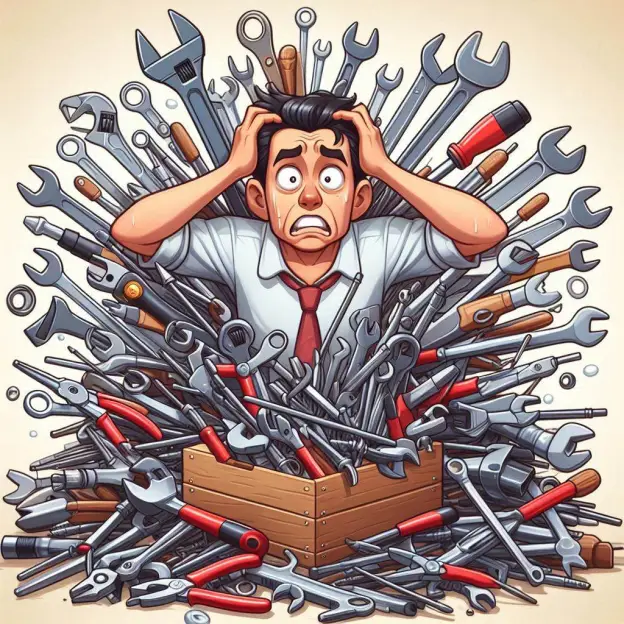
Adtech and martech — what I’ve started referring to as “Madtech” — are meant to make the massively complex work of modern marketing more manageable, but they often create more problems than they solve.
The explosion of devices, technologies, and channels, along with the subsequent work that must be done in order to establish a presence on each of them, has made effective and efficient digital marketing nearly impossible. It’s come to the point that no human marketer can be reasonably expected to keep up with the pace and scale of work that the modern media environment requires, and many are turning to additional assistive tools in an attempt to make sense of it all.
The problem is that adopting so many tools, each with their own set of functionalities and limitations, is only useful up to a point. It’s not just that the modern marketer has turned to digital tools to navigate today’s media landscape — it’s that he has to buy entirely new tools just so he can understand how to effectively use the tools he was using before. Eventually, mastering and managing so many tools becomes more difficult than it would have been to simply optimize your campaigns without any tools at all.
More Channels, More Problems
Single campaigns demand more and more attention as they’re spread across more channels. Campaign optimization requires a lot of tweaking across various platforms and devices — so much so that the marketers working tirelessly to maximize the impact of their campaigns are still struggling to produce significant returns on their investment.
And as marketers’ problems grow, so do customers’ expectations: they want more personalized interactions, and companies are spreading themselves thin to collect the data they need in order to do it. The problem is only further complicated by budgetary constraints, as search, email, display, and social jockey for importance and ad spend. Layer all the work of optimizing campaigns on top of managing ecommerce platforms (for online businesses), customer and prospect data, communication systems such as the website, blog, etc., and you’ve got a mountain of work that no one team could handle on its own.
As a result, most companies (with some notable exceptions) outsource advertising and marketing functions to media agencies or other technology vendors. This not only incurs significant costs, but makes it exceptionally difficult for brands to remain consistent and cohesive in their messaging across channels, and to truly own and manage THEIR data holistically.
Too Many Tools
Many companies are turning to multiple ad and marketing tech solutions — sometimes one for each new device, channel or need — that together require many people to operate and manage. Ranging from programmatic software, to various testing and optimization tools, to social advertising, email marketing and other channel based platforms, these tools can prove useful in isolation, but ultimately fail to simplify the work that marketers are expected to perform today.
Most adtech and martech solutions can either optimize campaigns on specific channels or manage and automate certain processes across multiple channels. A platform might be able to run an email campaign, for example, but in order to complete the user journeys on other channels like Facebook and AdWords, a marketer would need to add and manage an array of ad technologies that connect user experiences across platforms. Marketers need an all-encompassing solution that can both integrate into back-end systems and execute campaigns 24/7 without human intervention, not a complicated set of tools, that further reinforce silos, aren’t integrated and have narrow functionalities.
Some in the industry anticipate a convergence of adtech and martech in the near future, with a few big companies purchasing technology and media companies to better connect the processes of data collection and execution across paid and unpaid channels. However, this still leaves the problem of integrating tech stacks: while 58% of marketers say they want the simplicity of a single product suite, only 20% believe they can actually get everything they need from a single vendor. Furthermore, many companies never had the resources to hire an agency in the first place, and still struggle with badly fragmented operations.
Even companies with a “full stack” offering, are putting a ribbon on a package of siloed platforms. Without a single point of control and communication for the entire stack, your work won’t get any easier.
Artificial Intelligence Marketing
But there is a single solution: Artificial Intelligence marketing, which uses predictive analytics and machine learning to make it easy for marketers to plan, execute, test, optimize, and analyze cross-channel campaigns across both paid and unpaid channels. AI Marketing does the heavy lifting for marketers by making the work of launching and optimizing campaigns simpler on all relevant channels, so they can get back to focusing on what they’re good at — strategy, research, creative, messaging, and above all, higher-value problem solving.
Not only do AI Marketing performs many of the manual, time-consuming tasks associated with cross-channel marketing, but the systems actually learn, using prescriptive strategies to forecast user activity on the most granular of levels. They seamlessly integrate into critical systems within your current technology stack (such as web analytics, CRM, product inventory and CMS) in order to analyze and leverage historical data, and allow you to no longer have to invest in multiple ad and marketing tech point solutions. When it comes to modern digital marketing, you don’t need more tools — just a smarter one.


