
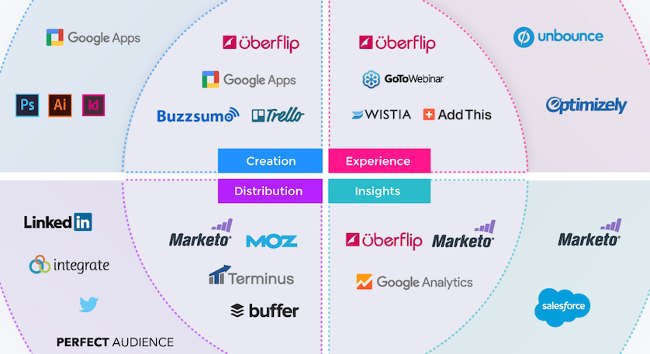
Rather than consolidating their systems, marketing networks seem only to be expanding, as more and more tools are developed to accommodate the growing number of media channels on which brands are expected to be present.
In the last 20 years, the field of marketing has undergone dramatic changes. Whereas advertising was relatively straightforward in the days of TV, print, and radio, the explosion of digital channels has complicated marketing beyond the point of human comprehension. Today’s marketers are faced with the challenge of finding and incorporating solutions for analytics, A/B testing, social media, email, mobile, etc. and connecting them all together in a way that makes sense for their business.
While giants like IBM and Adobe have tried to develop full marketing stacks to address this challenge, says Dov Yarkoni of Nielsen Innovate, the number of tools only continues to grow. Rather than easing the marketer’s burden, this explosion of channels and tools has only complicated matters further, making the reality of a single, consolidated platform that much more difficult – and the need for simplicity that much more pressing.
Fragmentation
Current marketing stacks are limited in their ability to provide a holistic view of ad performance, and instead only optimize certain processes while neglecting the others. Luma CEO Terry Kawaja explained this complexity in an interview with Digiday as a symptom of adtech’s growing pains as an industry, but noted that it’s generally seen as an incredibly frustrating problem. “Ask anyone in the ad ops groups or at the agency level and they’ll tell you it’s just too complicated,” he says. “A more mature industry would like to see these as solution sets that are brought together rather than stitched together.
This is often why many marketers are reluctant to commit to a single stack, opting to either outsource the account or build their own stack in-house with numerous “channel-based” marketers assigned to manage each piece. But because every organization has different needs, and every marketing team has their own processes, outsourcing or taking a DIY approach makes finding a single, comprehensive solution all the more difficult. Organizations come to mirror their fragmented tech stacks.
“The work to manage any one of those channels can be a full-time job, which most organizations… can’t support,” explains Liquidplanner CEO Liz Pearce. “So you wind up trying to hire people who can do some of everything and just hope that they can get enough data and information to prioritize their efforts.”
And for those enterprises with enough resources to dedicate personnel to each respective channel, specialization hinders marketers’ ability to collaborate. That makes the creation of seamless campaigns much harder to achieve, as not only consumers, but marketers struggle to link touchpoints to create seamless, omnichannel customer experiences.
Transparency
The adtech crisis not only makes the coordination of campaigns more difficult, but can indirectly lead to unnecessary costs. Without a good deal of transparency — the ability to know how much you’re paying each respective player in the adtech chain and for what — controlling expenses can become astronomically more difficult.
“Many companies added multiple technology layers that charge additional fees on top of the inventory cost that can add up to 50% to 70% [of the total expense],” Clearcode CEO Maciej Zawadzinski points out in another Digiday piece. Too often, companies form relationships with publishers and ad tech companies that don’t offer enough information about the quality and value of programmatic placements, meaning that organizations only have a partial picture both of what they’re paying and what they’re getting in return.
Because more and more channels and tools firmly establish themselves in the market every year, a fully consolidated marketing stack appears increasingly unlikely, if not impossible. Fortunately, far more efficient alternative solutions that actually simplify things for marketers and reduce the need for complex stacks and teams are coming to market.
Artificial Intelligence (AI) based marketing systems, for example, can not only easily integrate with existing tools and critical data sources within your current stack, but also replace many point based solutions along the campaigning process, such as individual testing & optimization tools, or channel-based solutions. And what’s more impressive about these solutions is that you’ll no longer need the number of resources you do to operate multiple, disparate, or even somewhat integrated systems.
Consolidation of adtech, both in terms of individual stacks and the industry itself, still seems a long way off. But selecting tools that offer transparency and are high-powered enough to connect entire your adtech infrastructure offer a promising solution to the fragmentation that the digital marketing landscape suffers from today.


